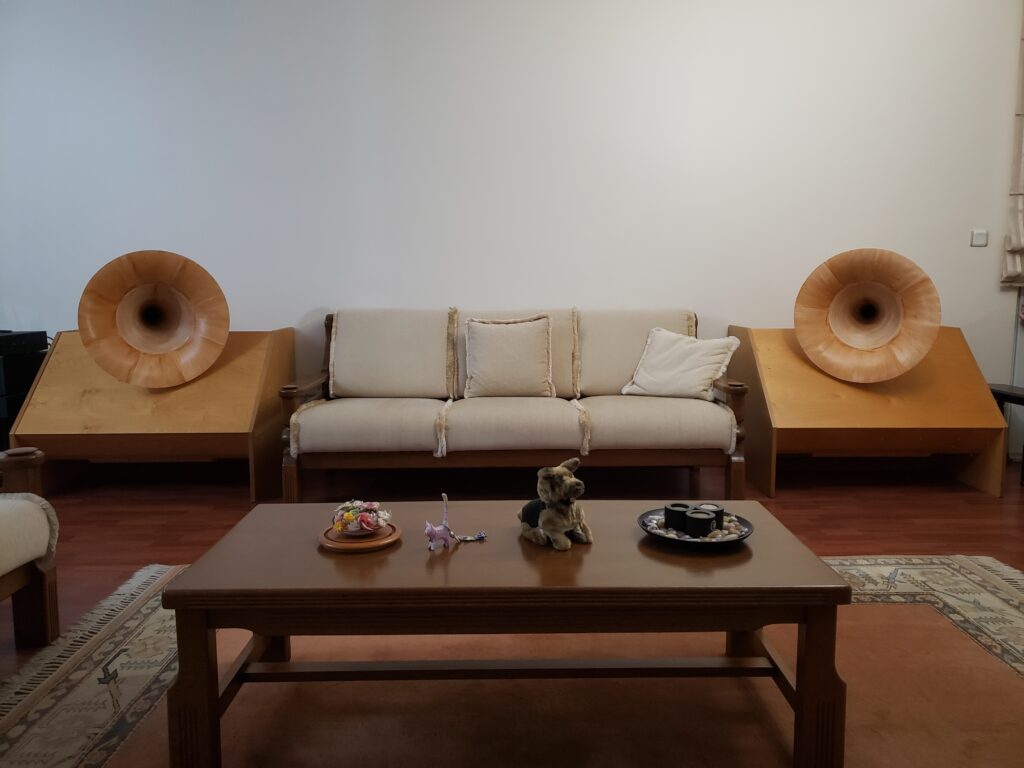
3-Way Active Horn-Loaded Audio System
(Update to “Construction of my sound reproduction system“)
1. System Upgrade & Evolution
I have recently implemented a major upgrade to my audio system, moving to a fully active configuration that significantly improves both technical performance and sonic accuracy. Here are the key changes in the new architecture:
- Horn Geometry Upgrade: The previous Tractrix mid horns have been replaced with 250Hz JMLC (Jean-Michel Le Cléac’h) horns, offering a more uniform acoustic loading down to 300Hz.
- Expansion to Fully Active 6-Channel Topology: The digital crossover and analog line stage have been expanded from 4 channels to a complete 6-channel discrete setup. By eliminating the passive filters on the tweeters and moving their division to the DSP, the time alignment across all drivers has been improved.
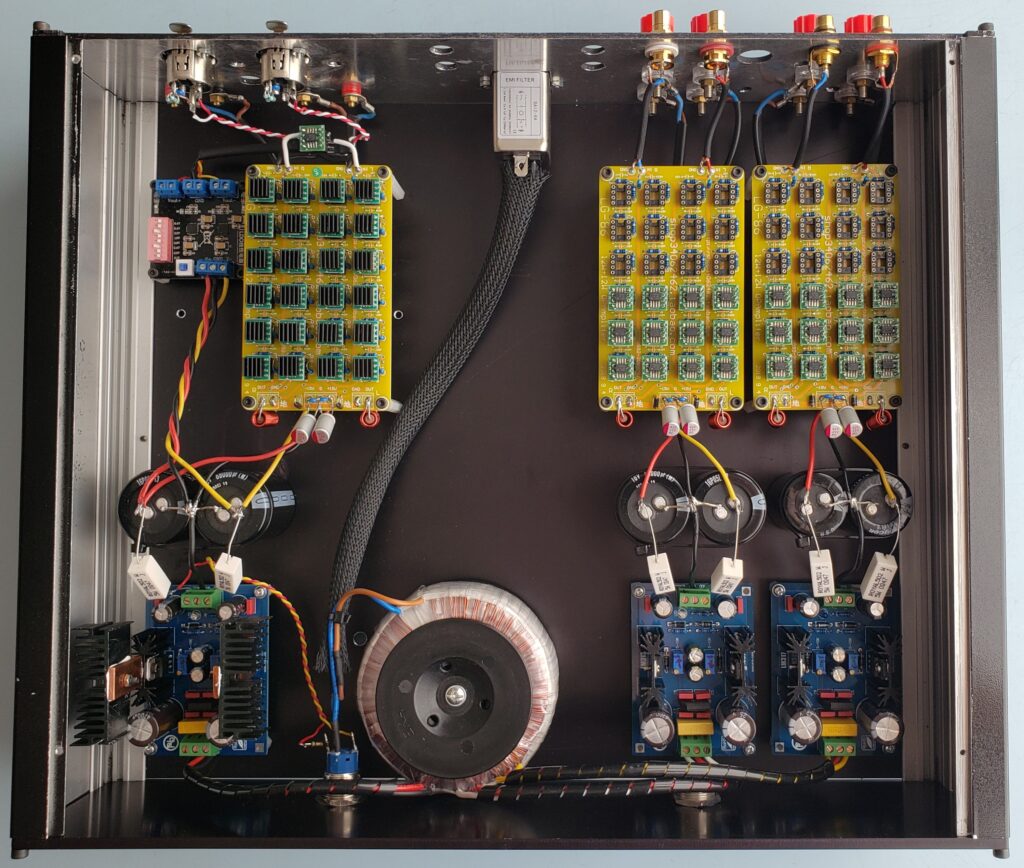
- Amplification & Buffer Stage Revolution: I have replaced the Hiraga Le Monstre amplifiers. In their place, the system now utilizes custom-built, parallel op-amp voltage follower buffers.
Sonic Impression: While the Le Monstre amplifiers delivered a clean, sweet, and pleasant musicality, this new parallel op-amp buffer configuration pushes the system to a higher level. The sound is now remarkably cleaner, detailed and more accurate.
2. System Overview
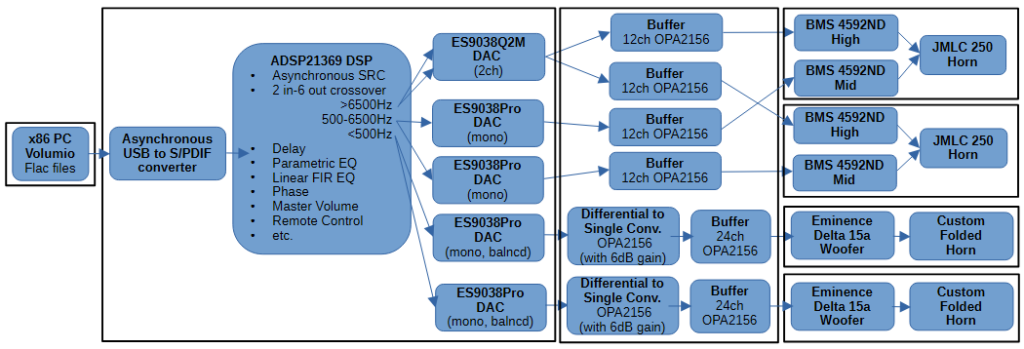
This project showcases a bespoke, fully active 3-way horn-loaded loudspeaker system built to uncompromising standards. The architecture embraces a completely digital infrastructure up to the multi-DAC stage, incorporating asynchronous sample rate conversion, high-order linear phase FIR (Finite Impulse Response) crossovers, and custom-built ultra-low noise operational amplifier arrays running in parallel.
3. Technical Specifications & Stage Analysis
Digital Frontend & DSP Core
- Digital Source: An x86-based dedicated PC running Volumio serves as the digital audio transport, streaming bit-perfect FLAC source files. The signal is fed via USB into an Asynchronous USB-to-S/PDIF converter to isolate computer clock jitter.
- DSP Processing Core: The core processing is handled by an Analog Devices ADSP-21369 SHARC DSP processor. This stage executes asynchronous sample rate conversion (SRC) and runs custom-designed 2-input, 6-output active digital crossovers.
- Acoustic Fine-Tuning: Beyond frequency routing, the DSP engine computes precise time-delay corrections, parametric equalization (PEQ), phase adjustments, and master volume control directly in the digital domain.
- FIR Filter Topologies: The acoustic crossover thresholds are configured with extreme steepness at 500 Hz and 6500 Hz using Linear Phase FIR filters providing attenuation slopes up to 200 dB/octave.
Digital-to-Analog Conversion (DAC) Layer
The system utilizes a total of five reference-grade ESS Sabre DACs configured to ensure maximum dynamic range, lowest distortion and crosstalk:
- High Frequencies (Stereo Channel): An ES9038Q2M 2-channel DAC handles the high-frequency bands.
- Mid Frequencies: Two independent ES9038Pro DACs operating in mono mode process the critical mid-frequency bands for left and right channels.
- Low Frequencies: Similarly, two dedicated ES9038Pro DACs operate in mono configuration, outputting differential signals for the low-frequency section.
Analog Line Stage & Buffers
The entire analog frontend uses parallel operational amplifier arrays configured as single-ended voltage followers.
- Mid & High Sections: Every single channel in the mid and high frequency buffer sections utilizes 12 parallelized Texas Instruments OPA2156 ultra-low noise, low-distortion JFET op-amps.
- Low Frequency Differential Stage: To offset the sensitivity delta of the woofers, the balanced outputs from the bass ES9038Pro DACs pass through a Differential-to-Single-Ended Converter based also on an OPA2156 that injects an additional gain boost of +6 dB. This is paired with a buffer containing 24 parallel OPA2156 op-amps per channel.
Acoustic Transducers & Horn Loading
- High (HF) & Mid (MF) Bands: Addressed by BMS 4592ND coaxial neodymium compression drivers, both the mid and high bands are acoustically loaded via 3D printed JMLC 250 (Jean-Michel Le Cléac’h) horns, achieving a sensitivity of 118 dB/W/m.
- Bass (LF) Band: Utilising a 38 cm (15″) Eminence Delta-15A woofer a Custom Folded Bass Horn achieves a low-end extension down to 25Hz with a sensitivity of 105 dB/W/m.